

Women's Straight Jeans
Women's straight jeans are the cut that works hardest in the wardrobe with the fewest demands — a parallel leg from hip to hem that asks nothing of the shoe, nothing of the top and creates no proportion problems wherever it goes. This edit covers high-rise and mid-rise styles in a range of washes, from raw indigo to stone, in denim with the weight and structure to hold its shape across seasons.
Why women's straight jeans are the most versatile cut in denim
The geometry of the straight cut is what makes it work everywhere. Unlike a skinny that demands a specific shoe and a wide leg that needs a specific top, women's straight jeans are genuinely indifferent to what you put with them — trainers, boots, loafers, heels, sandals, none of it creates a proportion problem. The high-rise straight jean is the most flattering version: the rise creates a defined waist point and the parallel leg reads as longer than it is. Women's straight jeans in high-cotton denim with a low elastane content have a cleaner structural fall than stretch blends — the leg drops straight without clinging to the calf or ballooning at the knee.
Washes and finishes in women's straight jeans
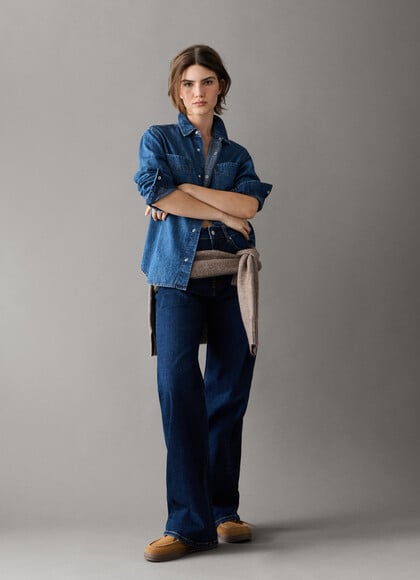
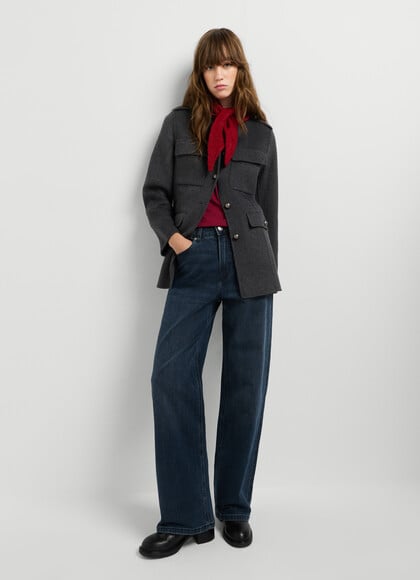
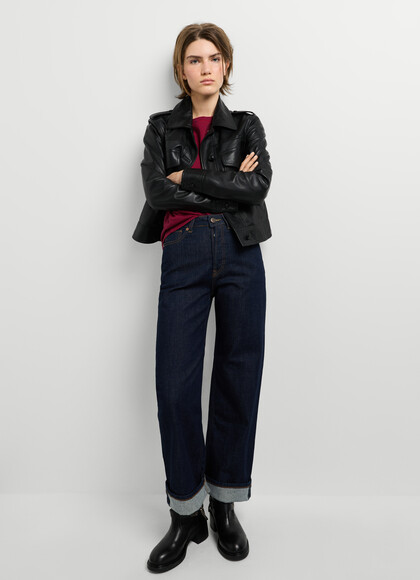
The wash defines the register. A mid-blue women's straight jean with subtle whisker fades at the thigh is the most versatile in the range — it earns its place from a Monday morning to a Saturday in Portobello without adjustment. Dark indigo, close to black, adds formality: tucked with a silk top and pointed flats, it does the work of a tailored trouser in most casual office contexts. Bleached and light stone-wash versions are the most relaxed and work best in summer with minimal tops. A raw hem or slightly frayed finish at the ankle is the most common detail in straight jeans — it reinforces the cut's character without overworking it.
How to wear women's straight jeans
Women's straight jeans in mid-blue with a heavyweight white cotton t-shirt and white low-profile trainers — that's the combination that's been working for decades and hasn't stopped. With a fine-knit top half-tucked and loafers, the same jean moves toward a considered everyday look. In dark indigo with a silk blouse fully tucked in and a pointed block-heel mule, the straight jean is evening-appropriate without changing anything else. The hem rolled once or twice reveals the ankle and works particularly well with chunky-sole trainers or low-heeled ankle boots — the detail changes the proportion without altering the cut.
Construction and Pepe Jeans London's denim expertise
Pepe Jeans London has been building straight-cut jeans since its founding on Portobello Road in 1973, and the women's straight jeans in this range reflect that accumulated knowledge: proportions calibrated by size so the parallel leg reads consistently from a size 6 to a size 18, inseam seams double-stitched at the points of highest stress, and denim selected for its behaviour over repeated washing — it holds its drape, its colour and its structure across seasons of use rather than softening into something formless.
What's the difference between women's straight jeans and wide-leg jeans?
The straight jean drops parallel from the hip with a leg opening close to the knee measurement — clean, undemanding, neutral. The wide leg starts with more volume at the hip and opens further toward the hem, creating more silhouette and requiring a more considered top to balance it. For everyday versatility, the straight is the easier choice; for a stronger visual statement, the wide leg delivers more but asks more in return.
How do I find my size in women's straight jeans?
Use both waist and hip measurements and check against the size guide for the specific style — proportions vary between a high-rise and a mid-rise cut even in the same numerical size. If your hip measurement pushes you toward a larger size than your waist, go with the hip and use a belt to adjust the waist. Inseam length is equally important: too long loses the clean parallel line at the hem.
How do I care for women's straight jeans?
Inside out at 30°C, no tumble dryer. Hang to dry from the waistband to preserve the straight fall of the leg. In high-cotton denim with little or no elastane, the less frequently you wash, the better the fabric develops — it builds its own character at the knee and hem fold that makes the jean more personal with time.