


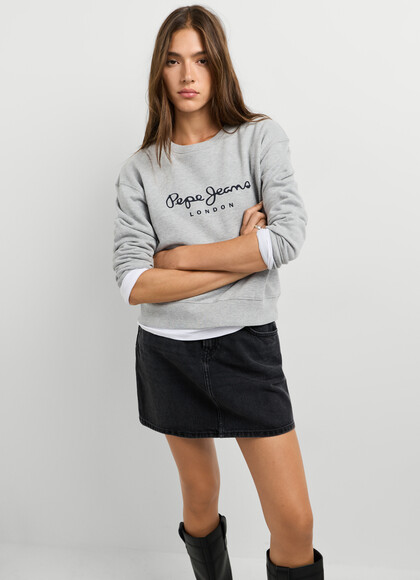
Women's Sweatshirts and Hoodies
Women's sweatshirts and hoodies are the pieces that do the most work in the cold-weather wardrobe — built for the kind of days that start with a morning run to a Portobello coffee and end with an evening on a candlelit rooftop in Soho. This edit covers crew necks, oversized graphic styles and hooded pieces in brushed-fleece cotton that actually keeps you warm, in colourways that work across the full wardrobe.
How to choose between women's sweatshirts and hoodies
The difference between a sweatshirt and a hoodie comes down to context and how you layer. A women's crew neck sweatshirt is the more considered piece — clean at the collar, no hood to manage, and it layers under a leather jacket or an overshirt without bunching at the neck. The women's hoodie is more relaxed and carries more of a casual identity, which makes it the right choice for weekends, travel and anywhere a jacket feels like overkill. The oversized women's sweatshirt — cut wider through the shoulders and longer at the hem — is the most versatile of the three: half-tucked into wide-leg jeans, it creates the proportion that most flatters.
Fabric weight and what it means
Weight is the specification that matters most. Between 280 and 320 g/m², a women's sweatshirt or hoodie becomes genuinely warm rather than just a thicker t-shirt — the brushed-fleece interior traps heat against the body and holds it through a full day. Below 250 g/m², it's a transitional piece for mild autumn evenings. The external surface matters too: a smooth face resists light wind better than a heavily textured one, and pilled fabric is always the first sign that the cotton wasn't tightly spun from the start — look for ring-spun cotton with an anti-pill finish in the product description.
How to wear women's sweatshirts and hoodies
A women's crew neck sweatshirt in grey or washed black half-tucked into straight-leg jeans, with white trainers and a small crossbody bag — that's the effortless everyday combination that earns its place in heavy rotation. The oversized women's sweatshirt worn loose over leggings or cycling shorts with chunky trainers is the most comfortable version of the format for weekends. For something more considered: a graphic women's hoodie layered under an open denim jacket, with wide-leg jeans and platform trainers — the graphic does the talking, everything else stays clean. Under a wool coat in November, a crew neck sweatshirt is the mid-layer that keeps the collar line uncluttered.
Construction and durability
Pepe Jeans London has built garment quality since 1973 and the women's sweatshirts and hoodies in this range reflect that: ring-spun cotton that resists pilling after dozens of washes, double-stitched side seams that maintain the shape of the body panel, and ribbed cuffs and hem in double-weight cotton that hold their elasticity through a full season. Printed graphics are applied to resist cracking after washing; embroidered logos sit flat without pulling the fabric underneath.
How do I size a women's sweatshirt or hoodie?
For regular-fit styles, use your chest measurement as the primary reference. For oversized styles, choose your usual size — the extra volume is already cut into the pattern. If you plan to layer the sweatshirt under a coat or jacket, going up one size gives a cleaner silhouette over thicker underlayers. Check shoulder width in the size guide if you're broad-shouldered.
How do I wash women's sweatshirts and hoodies without shrinking them?
Inside out at 30°C on a gentle cycle, no tumble dryer. Cotton fleece can shrink in length on the first wash if the temperature is too high — keeping to cold or cool water prevents this. Air dry hanging from the hem, not the shoulders, to avoid the collar and neckline stretching under the weight of wet fabric.
Can women's sweatshirts replace a jacket?
In mild conditions between 12 and 18°C, a heavyweight women's sweatshirt or hoodie at 300 g/m² or above works as a single outer layer in a sheltered city environment. Below that temperature or in wind and rain, it works best as a visible mid-layer under a denim jacket or a shell — showing at the collar and cuffs where the jacket doesn't cover.